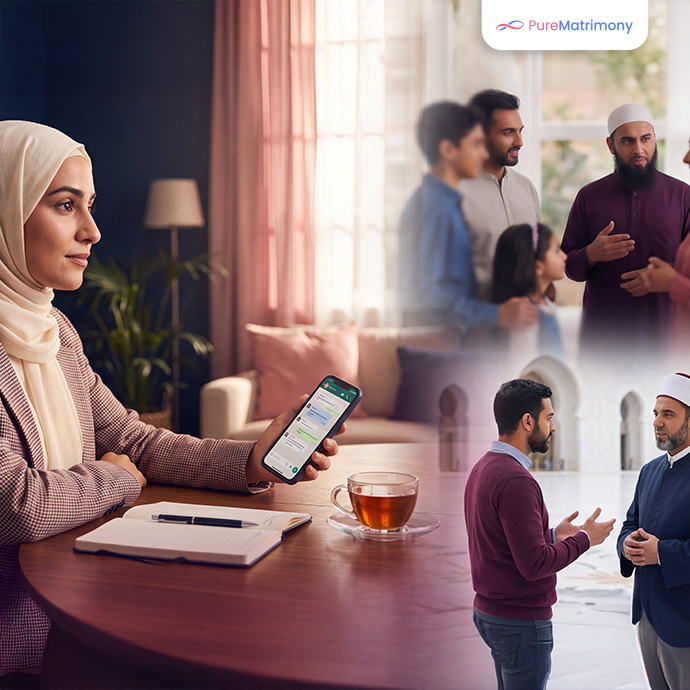
What Are the Halal Ways to Find a Muslim Spouse?
Islam does not prescribe one single method for finding a spouse. Instead, it provides principles that should guide every introduction, regardless of how two people meet.
The method may vary, but the process should always protect:
- Modesty
- Honesty
- Consent
- Good character
- Accountability
- Family involvement where appropriate
- Serious marriage intentions
This means a practising Muslim may meet a spouse through:
- Family and relatives
- Friends and trusted community members
- Local mosques
- Islamic marriage events
- A Muslim marriage website
- A Muslim marriage platform
- A Muslim matchmaking app
The introduction itself is not what makes the process halal.
The behaviour of the people involved is.
For the full process, from intention to Nikah, see our step-by-step guide to finding a spouse in Islam.
Route One: Family and Community Introductions
Family introductions remain one of the most trusted ways to find a Muslim spouse because they often include accountability and background knowledge.
Research from the Centre for the Study of Islam in the UK highlights how Muslim families and community networks continue to shape marriage processes in Britain, even as new digital tools emerge.
Parents, relatives, friends, and respected community members frequently know families personally. This makes it easier to verify important information before emotions become involved.
Advantages include:
- Existing trust
- Easier background checks
- Family support
- Shared values
- Greater accountability
However, family networks also have limitations.
Many practising Muslims today:
- Live far from relatives.
- Belong to small Muslim communities.
- Are reverts with no Muslim family.
- Work long hours.
- Have already exhausted local introductions.
Family introductions remain valuable, but they are no longer the only realistic route.
Read More: The Role of Family in Islamic Marriage
Route Two: Local Mosques and Islamic Communities
Mosques often help practising Muslims connect through trusted community networks and knowledgeable local leaders.
Many mosques quietly assist people searching for marriage by introducing suitable families or maintaining confidential matrimonial services.
Mosques also create opportunities to meet practising Muslims naturally through:
- Islamic classes
- Volunteering
- Community projects
- Charity work
- Youth programmes
These environments allow people to observe character over time rather than relying solely on an online profile.
Not every mosque offers formal matchmaking, but many Imams are willing to advise families and support suitable introductions.
Route Three: Islamic Marriage Events
Islamic marriage events bring together serious marriage seekers in supervised environments designed around compatibility rather than casual dating.
Across the UK, many organisations arrange Muslim marriage events where attendees can meet potential spouses respectfully.
These events typically include:
- Registration
- Identity checks
- Structured conversations
- Organised introductions
- Family-friendly settings
- Clear marriage intentions
They work particularly well for practising Muslims who prefer face-to-face interaction.
However, they are usually limited by:
- Geography
- Event frequency
- Travel requirements
- Limited attendee numbers
For many Muslims, they become one part of a wider marriage search rather than the only method.
Route Four: Muslim Marriage Apps
This has become one of the most practical halal routes because it helps practising Muslims search beyond their immediate social circle while keeping marriage as the objective.
Many Muslims immediately compare online matchmaking with dating apps.
That comparison is not always accurate.
A Muslim marriage app designed around Nikah should encourage:
- Serious marriage intentions
- Compatibility-based searching
- Respectful communication
- Privacy controls
- Profile verification
- Family or Wali involvement
- Continuous moderation against inappropriate behaviour
Unlike casual dating platforms, the objective should always be to help two compatible Muslims move towards marriage.
Technology is simply another method of introduction.
Islamic values still determine whether the process remains halal.
Is Using a Muslim Marriage App Halal?
Using an Islamic marriage app can be permissible when the purpose is marriage and communication remains within Islamic boundaries.
The method of introduction is not the issue.
The conduct is.
Responsible users should:
- Be honest in their profile.
- State their marriage intentions clearly.
- Avoid flirtation and unnecessary intimacy.
- Ask meaningful compatibility questions.
- Verify important information.
- Involve trusted family members where appropriate.
- Arrange meetings safely.
- Make istikharah before important decisions.
The Prophet ﷺ encouraged marriage for those who are able because it helps lower the gaze and protect chastity. Those unable to marry were encouraged to fast. (Sahih al-Bukhari)
This reminds Muslims that marriage itself is encouraged, while the process leading towards it should remain honourable.
Route Five: Muslim Marriage Websites
A Muslim marriage website offers similar benefits to an app while giving users the flexibility to search through a desktop or mobile browser.
Some people prefer websites because they allow:
- Larger profile layouts
- Easier messaging
- Better document management
- More detailed compatibility information
Whether someone chooses an app or website is largely a matter of convenience.
The important question is whether the platform encourages responsible introductions.
What Makes a Muslim Marriage Platform Different From a Dating App?
A purpose-driven Muslim marriage platform is built around Nikah, while dating apps are generally built around casual interaction.
| Muslim marriage platform | Dating app |
| Marriage is the objective | Dating is often the objective |
| Religious compatibility matters | Appearance may dominate matching |
| Family involvement can be encouraged | Family involvement is uncommon |
| Conversations should have direction | Conversations may remain open-ended |
| Privacy and modesty are prioritised | Public visibility often increases engagement |
| Members are expected to seek marriage | Intentions may vary significantly |
A platform should make it easier to remain focused on marriage rather than encouraging endless browsing.
Scholars at the Al‑Mahdi Institute have examined how classical Islamic principles are being applied to modern realities, including the growth of halal, marriage‑focused platforms and other services.
What Should You Look for in a Muslim Marriage App?
Not every Muslim matchmaking app offers the same level of safety or seriousness.
Look for features such as:
- Verified member profiles
- Active moderation
- Privacy controls
- Wali involvement
- Detailed compatibility filters
- Religious preference options
- Clear community guidelines
- Reporting systems
- Serious marriage-focused members
Shariah-compliant platforms are designed for purpose-driven matchmaking, not simply increasing user activity.
How Does Pure Matrimony Support Halal Matchmaking?
Pure Matrimony was created specifically for practising Muslims seeking marriage rather than casual relationships.
The platform focuses on:
- Practising Muslims
- Serious marriage seekers
- Privacy-first profiles
- Compatibility-based searching
- Optional family/Wali involvement
- Respectful communication
- A Nikah-focused approach
Rather than encouraging endless conversations, the platform aims to help members assess compatibility and move towards marriage responsibly.
Like every introduction, success still depends on honesty, good character, and sincere intentions.
Practical Advice for Online Muslim Matrimony
Technology should support your search, not replace Islamic guidance.
Whether you use an Islamic marriage app or receive an introduction through family, the same principles apply.
Always:
- Keep your intentions clear.
- Ask important questions early.
- Verify identity and circumstances.
- Involve trusted people.
- Avoid emotional attachment before compatibility is established.
- Respect Islamic boundaries.
- Perform Istikharah before making a final decision.
A halal search is not defined by where two people meet.
It is defined by how they conduct themselves throughout the process.
Read More: How to Find the Perfect Matrimonial Site for Your Needs as a Muslim
Search for Marriage with Purpose
Finding a spouse should never require compromising your Islamic values.
Pure Matrimony helps practising Muslims search within a marriage-focused environment built around compatibility, privacy, and serious intentions.
Whether you begin with family, your mosque, or a Muslim marriage app, it’s another trusted route towards Nikah.
Final Thoughts
Islam has never limited Muslims to one method of finding a spouse.
What it provides are timeless principles that protect faith, dignity, and accountability throughout the process.
The question is not whether technology is halal.
The real question is whether the way we use it brings us closer to a marriage that pleases Allah.
Choose a route that strengthens your Deen, protects your boundaries, and helps you search with sincerity rather than desperation.
Leave a Reply