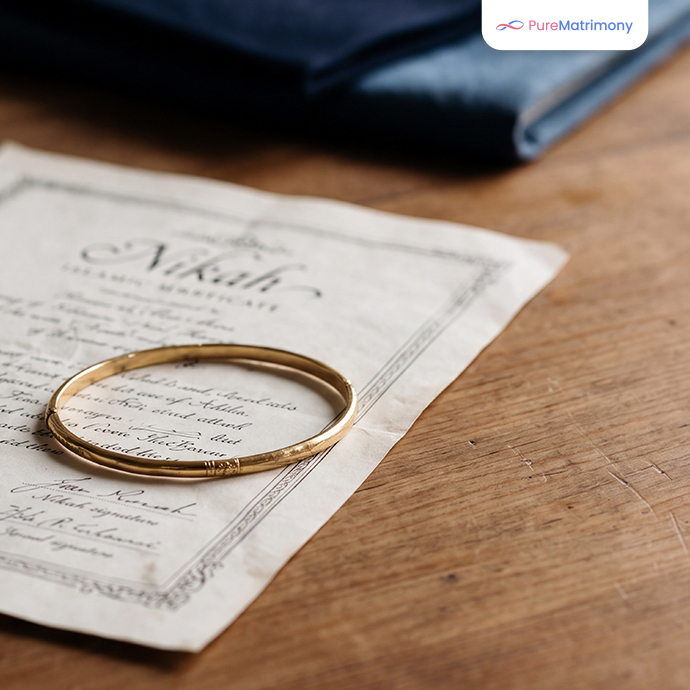
Mahr, Mehr, Haq Mehr: One Obligation, Many Names
Couples often use several words for the same thing, and it is worth clearing them up before anything else.
“Mahr” is the Arabic term used by the jurists. “Mehr” or “Meher” is how the same word is usually said and spelled in South Asia and in British Pakistani, Indian, and Bangladeshi families.
“Haq Mehr” simply means “the right of Mahr”, a reminder that it is the bride’s right rather than a favour. Classical books also use “Sadaq”, and English legal writing often uses “dower”.
The Quran itself does not use the word “Mahr”. It speaks of women’s Saduqat (gifts given in sincerity) in 4:4 and their Ujur (their due) in 4:24. All of these point to one obligation.
The one translation to avoid is “dowry”. In South Asian usage, dowry (Jahez or Dahej) runs the other way, from the bride’s family to the groom’s side, and Islam does not require it. Our guide to Mahr vs dowry explains the differences in full.
What the Quran and Sunnah Say About Mahr
The Quranic Basis
The clearest command is Quran 4:4: “And give the women (upon marriage) their (bridal) gifts graciously. But if they give up willingly to you anything of it, then take it in satisfaction and ease.”
The verse does two things. It makes the gift a duty owed to the wife, and it gives her, and only her, the choice to hand any of it back. Quran 4:24 repeats the point when it tells husbands to give wives “their due compensation as an obligation”.
Is Mahr Compulsory?
Yes. Mahr is an obligation of every Nikah, and a husband cannot contract it away. What surprises many people is that a Nikah in which no amount was named is still generally treated as valid. The Mahr is not cancelled; it is simply owed at a standard level.
The evidence comes from a case the Prophet ﷺ decided himself. Jami’ at-Tirmidhi 1145 reports that Ibn Mas’ud was asked about a man who married without fixing a Mahr and died before the marriage was consummated. He ruled that she should receive the Mahr of women like her, “no less and no more”, along with inheritance. A Companion then confirmed that the Prophet ﷺ had judged the same for Birwa bint Washiq. Quran 2:236, which addresses divorce where no obligation had been specified, also assumes such a marriage existed.
Scholars call this standard amount Mahr al-Mithl, the Mahr of a woman of similar standing. The schools differ on some details, so treat this as the general rule and ask a scholar about a particular case.
Who Does the Mahr Belong To?
The Mahr is the wife’s own property. It is not a payment to her parents, and it is not a fund for the wedding.
IslamQA, in an answer by Shaykh Muhammad Salih al-Munajjid, describes the Mahr as “the right of the wife” and says her father may not take it without her consent. IslamOnline adds a practical point: if the groom hands the Mahr to the bride’s father, that is acceptable, but the father must pass it on to her.
Three further rules follow from the same principle.
- She may give it up, but only freely. Under Quran 4:4, a wife may waive part or all of her Mahr. Darul Iftaa Birmingham stresses that this must be her own choice, made “without any pressure”.
- The husband cannot take it back. Quran 4:20 says that even if a husband has given “a great amount”, he must “not take (back) from it anything”. The main exception is Khul’, where a wife asks to end the marriage and may return the Mahr (Quran 2:229).
- An unpaid Mahr is a debt. If the husband dies before paying it, Darul Iftaa Birmingham explains that it is treated as an outstanding debt, paid from his estate.
What Can Be Given as Mahr?
Money, Gold and Property
Most Mahr today is cash, a bank transfer, gold jewellery or, less often, property. What matters is that it has real value, both sides know exactly what it is, and the bride has agreed to it.
When the Gift Is Not Money
Two narrations show that a Mahr does not have to be expensive or even involve money.
In Sahih al-Bukhari 5135, a man wanted to marry but owned only the cloth he was wearing. The Prophet ﷺ told him to look for something, “even if it were an iron ring”. When he found nothing, the Prophet ﷺ married the couple for the Quran the man knew, which he would teach her.
In Sunan an-Nasa’i 3341 (graded Hasan by Darussalam), Umm Sulaym told Abu Talhah that she could not marry him while he was not Muslim, and that if he accepted Islam, that would be her Mahr. He did, and it was. Notice who set the terms: the bride herself.
These narrations give couples of modest means real room. They do not mean a bride’s wishes can be brushed aside; in both cases, the gift was something she accepted.
When Is the Mahr Paid?
The Mahr can be paid in two ways, and many couples combine them.
A prompt Mahr (Mu’ajjal) is due at the Nikah or whenever the wife asks for it. A deferred Mahr (Mu’akhkhar) is paid at an agreed later date and otherwise falls due if the marriage ends by divorce or death. A common arrangement is to pay part now and defer the rest, with the deferred part acting as security for the wife.
What each type means for the bride’s rights, including on divorce, is covered in our guide to the types of Mahr.
How Much Should the Mahr Be?
Islam sets no upper limit; Quran 4:20 itself speaks of a husband having given “a great amount”. Some schools do set a minimum, and they do not all agree on the figure. Alongside this, the Sunnah encourages a Mahr that is fair and does not make marriage a burden.
The minimum in each school, the Mahr the Prophet ﷺ gave, and how to turn old silver and gold measures into today’s money are all in our guide to how much the Mahr should be.
Agreeing the Mahr Before Your Nikah
Most of the problems couples have with Mahr come from vague agreements, not from the ruling itself. A clear process avoids most of them.
- Let the bride lead. It is her right, so her view comes first. She can take advice from her Wali and family, but the decision should be hers.
- Raise it early. Talk about the Mahr during the engagement conversation, not on the day of the Nikah, when nobody wants to disagree in front of guests.
- Be specific. Name the exact sum, or the weight and carat of any gold, rather than “some jewellery”. Vague terms are where later disputes begin.
- Decide the timing. Agree on how much is prompt and how much is deferred, and if anything is deferred, when it will be paid.
- Write it down. Record the amount, form and timing in the Nikah contract or certificate, read it out before the witnesses, and keep a copy each.
- Record the payment. When the prompt Mahr is handed over, note it and keep a record of any deferred payments as they are made.
For couples in the UK, one more point. English courts have sometimes treated an agreed Mahr as a contract. In Uddin v Choudhury (2009), the Court of Appeal refused to disturb a county court judgment ordering unpaid sums agreed before the marriage, which the judgment calls “dowry”, to be paid to the bride.
Outcomes depend on the facts, and a Nikah on its own is usually not a legally registered marriage in England and Wales, so take independent legal advice if you want your Mahr to be enforceable.
Looking for a Spouse Who Values the Sunnah?
The Mahr works best between two people who already agree on what a marriage in Islam should look like.
PureMatrimony is a marriage platform for Muslims, where members are serious about Nikah and sisters can involve their Wali from the start.
Create your free profile to begin your search.
The Takeaway
The Mahr is a gift that the Quran makes compulsory, owed by the husband and owned by the wife. It can be large or modest, money or something of real benefit, paid now or later.
What it must be is agreed freely, recorded clearly, and honoured in full. Talk about it early, write it down, and ask a scholar you trust if anything about your situation is unclear.
Leave a Reply