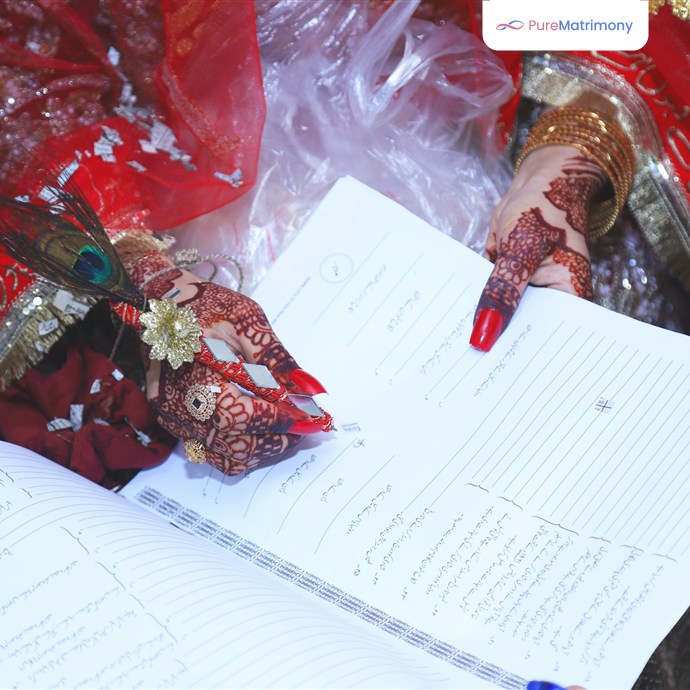
What Does “Nikah” Mean?
Nikah is an Arabic word used in the Quran and Sunnah for marriage. In everyday use it means the marriage contract: the moment two people become husband and wife in the sight of Allah. You will see it spelt Nikah, nikkah and nikaah. They all mean the same thing.
The Quran describes marriage as “a firm covenant” (Quran 4:21), and it describes spouses as a source of tranquillity, with “affection and mercy” placed between them (Quran 30:21). The Prophet ﷺ made marriage part of his Sunnah. When three men vowed to pray all night, fast every day and never marry, he told them that he prayed and slept, fasted and broke his fast, and married women, “so he who does not follow my tradition in religion, is not from me” (Sahih al-Bukhari 5063).
The most important point is the simplest: once a valid Nikah has taken place, the couple are married in Islam, even if the wedding party is months away.
Is a Nikah a Contract or a Ceremony?
Three different things are often called “the Nikah”, and separating them clears up most of the confusion.
- The contract. The agreement itself: the offer, the acceptance, the Mahr and any conditions the couple agree. This is the marriage.
- The ceremony. The gathering where the contract is concluded, often at a mosque or at home, usually with a short sermon and duas. It can take as little as 15 minutes.
- The Walima. The wedding meal given after the marriage, which is a Sunnah of its own.
Families sometimes hold all three on one day. Many British Muslim couples hold the Nikah first, quietly, and the Walima or a larger reception later. Either way, the contract is the part that makes them married.
What Makes a Nikah Valid?
Scholars of all four schools agree on the core of a valid Nikah in Islam, though they differ on some details and on which items they class as pillars (arkan) or conditions (shurut). In practice, a valid Nikah needs the following five things.
1. Consent of Both Parties
Both the bride and the groom must agree freely. A hadith in Sahih al-Bukhari requires that a divorced or widowed woman be consulted and a first-time bride be asked for her permission before either is married (Sahih al-Bukhari 5136). And when a father married his daughter, Khansa bint Khidam, to someone she had not chosen, the Prophet ﷺ annulled it (Sahih al-Bukhari 5138). No parent, guardian or imam can override this.
2. Offer and Acceptance (Ijab and Qabul)
One side makes a clear offer of marriage, usually the bride’s Wali or representative (“I marry you to my daughter … for the Mahr of …”), and the groom clearly accepts (“I accept”). The words must be unambiguous and refer to marriage now, not a promise of marriage later.
Scholars also require the offer and acceptance to happen in one sitting, so that the acceptance answers the offer directly, in front of the witnesses. This is why many scholars are cautious about Nikahs concluded over a video call. A common solution, described by SeekersGuidance, is for each party to appoint a representative (wakil) who attends in person, so the offer, acceptance and witnesses are all in one place (SeekersGuidance).
3. The Wali (Guardian)
The Maliki, Shafi’i and Hanbali schools require the bride’s Wali, usually her father, for the contract to be valid. The Hanafi school allows an adult woman to conclude her own Nikah to a suitable match, while still strongly encouraging her guardian’s involvement. Whichever school you follow, the Wali’s role is to protect the bride’s interests, never to force a match on her.
4. Two Witnesses
The contract must be witnessed. IslamQA cites the narration “There is no marriage contract except with a Wali and two witnesses” (IslamQA 2127). Witnesses are normally two adult Muslim men of good character, and the Hanafi school also accepts one man and two women. Witnesses matter beyond the ceremony itself: if a marriage is ever questioned, they are the people who can confirm it took place.
Islam also encourages making a marriage known rather than hiding it. The Prophet ﷺ said that what distinguishes the lawful from the unlawful is the duff and the voice, meaning the public celebration of a wedding (Jami’ at-Tirmidhi 1088, graded hasan by Darussalam).
5. The Mahr
The Mahr is the gift the groom gives the bride, and it becomes her property. Allah says: “And give the women [upon marriage] their [bridal] gifts graciously” (Quran 4:4). It is normally named in the contract. If it is not, scholars hold that the marriage is still valid and the bride is owed a fair Mahr in line with women like her: Ibn Mas’ud ruled exactly this for a woman whose Mahr had not been set (Jami’ at-Tirmidhi 1145, graded sahih by Darussalam). Our guide to what Mahr is in Islam explains the rest, and how much Mahr should be covers the amount.
Beyond these five, the couple must be free to marry each other: not already related in a way that makes marriage forbidden, and, for a Muslim woman, marrying a Muslim man. The rules on marrying outside Islam are explained in our guide on whether a Muslim can marry a non-Muslim. Details differ between the schools, so if anything about your situation is unusual, ask a local scholar to confirm it.
What Happens at a Nikah?
Nikah ceremonies vary between communities, but most follow the same basic shape:
- The imam or officiant confirms the bride’s consent, the Wali, the witnesses and the agreed Mahr.
- A short sermon (khutbah) is given, usually including Quranic verses on marriage and taqwa.
- The offer and acceptance are made in front of the witnesses, and the Nikah certificate is signed.
- Duas are made for the couple, and guests congratulate them, often with the dua “Barakallahu laka wa baraka ‘alayka wa jama’a baynakuma fi khayr”. You can find it, with its meaning, in our article on dua for marriage.
Many couples choose a date that carries meaning for them. Our article on having a Nikah in Dhul Hijjah looks at one example.
Is a Nikah Legally Recognised in the UK?
Religious validity and legal recognition are two separate questions. A Nikah is judged by Islamic criteria. Whether it is also a legal marriage in England and Wales depends on civil law: GOV.UK explains that a religious wedding counts as a legal marriage when it is held at a religious building registered for marriages and an authorised person attends and signs the marriage schedule or document (GOV.UK).
Many Nikahs do not meet these conditions, for example a Nikah held at home or in a mosque that is not registered for marriages. In that case the couple are married in Islam but not in law, which can leave a spouse, usually the wife, without legal protection if the marriage ends or a spouse dies. Many couples therefore also hold a civil ceremony, on the same day or separately. If your situation is not straightforward, get independent legal advice. Scotland and Northern Ireland have their own rules.
Nikah, Walima and the Wedding: What’s the Difference?
| What it is | When it happens | Is it required? | |
|---|---|---|---|
| Nikah | The marriage contract | First | Yes, it is the marriage |
| Walima | The wedding meal given by the groom | After the Nikah, usually after the marriage begins | A Sunnah, strongly encouraged |
| Wedding reception | A cultural celebration | Any time | No |
The Walima has its own evidence: when Abdur-Rahman ibn Awf married, the Prophet ﷺ told him, “Give a banquet, even if with one sheep” (Sahih al-Bukhari 5167). Note the words “even if”: the Walima should fit the couple’s means. A large reception is optional, and nothing about it changes whether the couple are married.
Planning Your Nikah: What to Sort Out First
- Confirm the Wali. Normally the bride’s father; if he is unable to act, the role passes to another relative or the mosque can advise.
- Agree the Mahr and write it down. The amount, its form, and whether any part is deferred.
- Arrange two witnesses. Choose people who will be present and who meet the conditions.
- Choose who will conduct it. An imam or knowledgeable person who will check the conditions properly.
- Check what the mosque needs. ID, proof of Islam for reverts, the Wali’s details and notice periods vary.
- Decide on civil registration. Whether to register at the same time or hold a separate civil ceremony.
- Talk through expectations. Where you will live, money, family roles. Our guide to the engagement conversation covers what to discuss.
If you have not found your spouse yet, our step-by-step guide to finding a spouse in Islam takes you from intention to Nikah.
Begin With the Right Match
Every Nikah starts with two people who share the same values. Pure Matrimony is a marriage platform for practising Muslims, where you can involve your Wali and family from the first conversation and keep the whole search focused on marriage. Create your free profile and take the first step towards your own Nikah.
Leave a Reply