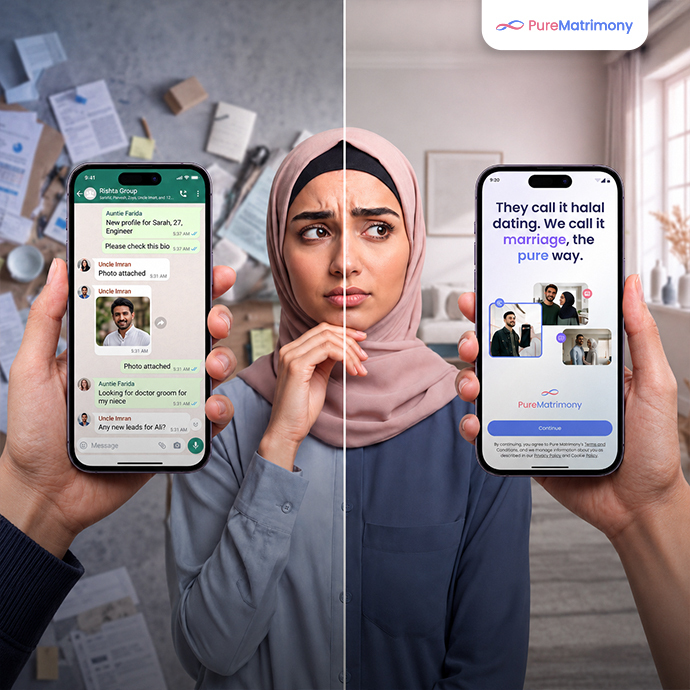
How Do WhatsApp Rishta Groups Work?
WhatsApp rishta groups connect people through shared profiles posted in group chats.
Typically, an administrator creates a group where members or family representatives share basic information about someone seeking marriage. Interested individuals then contact the relevant person privately to discuss compatibility.
Many Muslims use these groups because they are:
- Easy to join.
- Free in many cases.
- Community-driven.
- Managed by local volunteers or trusted individuals.
For some people, they have successfully led to marriages. However, every group operates differently, and there is rarely a standard process for profile verification, privacy, or moderation.
Why Do Muslims Use WhatsApp Rishta Groups?
Many practising Muslims appreciate the familiarity and sense of community in WhatsApp groups.
Some common reasons include:
- Recommendations from family or friends.
- Local community connections.
- Simplicity and convenience.
- Quick introductions.
- Cultural familiarity.
For families who already know one another, this informal approach may feel comfortable and effective.
What Are the Disadvantages of WhatsApp Rishta Groups?
The biggest challenge is inconsistency. Every group has different rules, standards, and levels of moderation.
Potential limitations include:
- Limited profile information.
- Little or no profile verification.
- Large numbers of inactive members.
- Repeated forwarding of personal details.
- Reduced privacy in matchmaking.
- Difficulty filtering compatibility preferences.
- Conversations moving outside the original group without structure.
This does not mean every WhatsApp group is unsafe. Many are managed responsibly. However, users should always be cautious when sharing personal information online and verify details before progressing any marriage discussions.
Why Is Pure Matrimony Different?
Pure Matrimony is designed specifically for practising Muslims seeking marriage through a structured and Deen-centred process.
Rather than relying on group messages, users create detailed profiles that help others understand their background, practising level, and marriage intentions.
Features commonly associated with a structured matchmaking platform include:
- Dedicated marriage profiles.
- Compatibility preferences.
- Organised matrimonial process.
- Privacy settings.
- Wali involvement
- Purposeful matchmaking.
- Marriage-focused community.
- Genuine marriage proposals from people actively seeking marriage.
This allows members to spend less time sorting through unsuitable introductions and more time focusing on meaningful compatibility.
Profile Verification and Privacy Matter
Trust is one of the most important parts of online matrimony.
When searching for a spouse online, many practising Muslims understandably want reassurance that the information they are viewing is genuine.
A safe matrimonial platform can help by offering features such as profile verification processes, moderation, and privacy controls that are not typically available in informal messaging groups.
No online platform can remove every risk, but having clear processes can help members make more informed decisions.
The Importance of Serious Marriage Intentions
Finding someone who genuinely wants marriage is often more important than simply finding more people.
One challenge with informal introductions is that intentions are not always clear.
On a dedicated marriage platform, members generally join with one purpose: finding a compatible spouse.
This creates an environment that encourages:
- Serious marriage seekers.
- Respectful communication.
- Long-term compatibility.
- Clear marriage intentions.
For practising Muslims, this focus can make the search feel more purposeful.
Pure Matrimony vs WhatsApp Rishta Groups
| Feature | WhatsApp Rishta Groups | Pure Matrimony |
| Purpose | Community introductions | Dedicated marriage platforms |
| Profiles | Basic shared messages | Structured matrimonial profiles |
| Compatibility preferences | Usually limited | Detailed filtering options |
| Privacy | Depends on each group | Privacy controls within the platform |
| Profile verification | Varies by group | Verification processes where applicable |
| Marriage intentions | Can vary | Marriage-focused community |
| Search experience | Manual browsing | Organised matrimonial platform |
Is Online Muslim Matrimony Halal?
Yes, online Muslim matrimony can be halal when it is used with the correct intentions and within Islamic guidelines.
The platform itself is simply a means of introduction.
What matters is how it is used.
Practising Muslims should:
- Keep conversations respectful.
- Involve family or a Wali where appropriate.
- Maintain Islamic boundaries.
- Focus on compatibility rather than casual interaction.
- Seek marriage sincerely rather than entertainment.
Technology can facilitate introductions, but Islamic principles should always guide the process.
Which Option Is Right for You?
There is no single approach that suits everyone.
WhatsApp rishta groups may work well for people seeking introductions within their existing community.
However, if you prefer greater organisation, detailed compatibility preferences, stronger privacy controls, and an environment designed specifically for practising Muslims, a platform like Pure Matrimony offers a more structured approach to finding a spouse.
The important thing is not simply where you search.
It is that your search reflects your values, your intentions, and your trust in Allah.
Looking for a More Structured Way to Find Your Spouse?
Finding a spouse should feel purposeful rather than overwhelming.
If you value privacy, compatibility, and a marriage-focused environment rooted in Islamic principles, Pure Matrimony provides a structured way to connect with practising Muslims who share your intention of building a lasting marriage.
Begin your search with confidence, sincerity, and trust in Allah’s plan.
Leave a Reply